Internal Cooking Temperature Chart: Safe Meat, Poultry, Fish and Leftover Temperatures
An internal cooking temperature chart helps you know when chicken, beef, pork, fish, eggs, casseroles and leftovers are properly cooked inside. Timing can help, but temperature is the most reliable way to check doneness, especially with thick cuts, ground meat, poultry and reheated food.
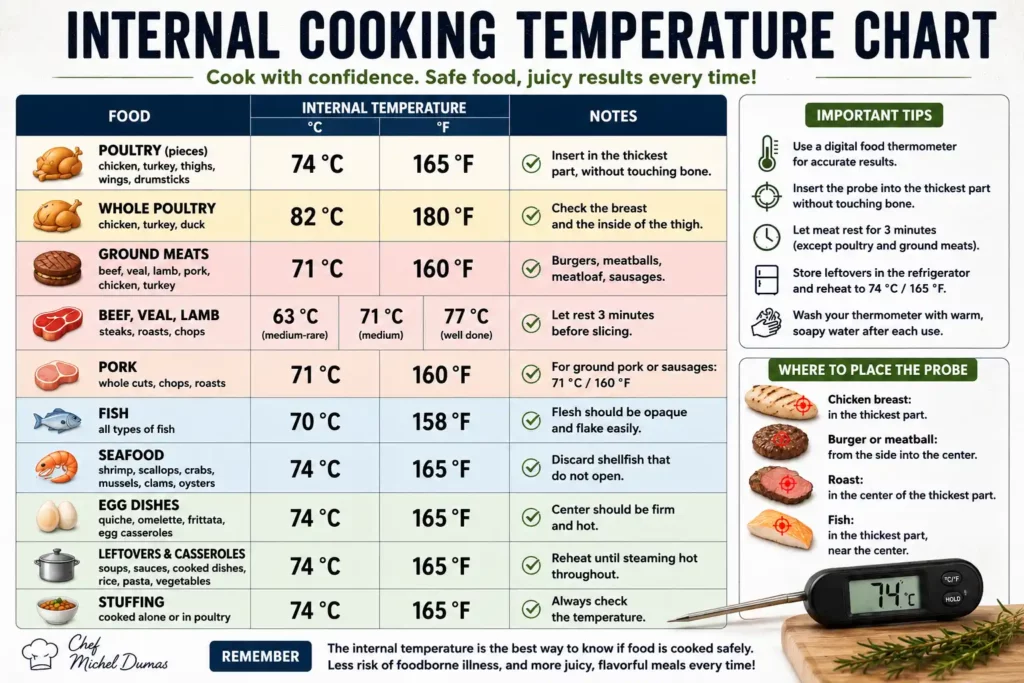
For home cooking in Canada and the USA, a digital food thermometer is one of the simplest tools for better results. It helps avoid undercooking, but it also helps avoid overcooking chicken, pork, fish and roasts. I prefer to cook with temperature instead of guessing by colour because colour can be misleading, especially with poultry, ground meat and larger cuts.
Why This Guide Matters
A recipe can give a cooking time, but time is never perfect. A chicken breast may cook faster or slower depending on thickness. A roast changes depending on size, shape, oven temperature and whether it started cold from the fridge. Burgers can brown on the outside before the centre is fully cooked.
That is why internal temperature matters. It gives a clear reading from inside the food.
Food safety authorities in Canada and the United States both recommend using a food thermometer for meat and poultry. Health Canada lists safe internal cooking temperatures in Celsius and Fahrenheit, while the USDA FSIS publishes safe minimum internal temperatures for meats, poultry, fish, eggs and leftovers. (Canada)
This guide is meant for everyday cooking: chicken dinners, burgers, roasts, pork chops, fish, casseroles, meatballs, air fryer recipes, BBQ meals and leftovers. It is also useful for recipes like juicy air fryer chicken breast, air fryer chicken thighs, chicken fajitas and easy 30-minute chicken dinners, where the difference between juicy and dry can come down to a few degrees.

Quick Answer
Here are the most important internal cooking temperatures to remember:
- Poultry pieces: 165°F / 74°C
- Ground poultry: 165°F / 74°C
- Whole poultry: 180°F / 82°C in Canada guidance
- Ground beef, pork, lamb and veal: 160°F / 71°C
- Beef, pork, veal and lamb steaks, chops and roasts: 145°F / 63°C with a rest time in USDA guidance
- Fish: 145°F / 63°C in USDA guidance, while Health Canada lists 158°F / 70°C
- Leftovers and casseroles: 165°F / 74°C
- Egg dishes: 160°F / 71°C in USDA guidance, while Health Canada lists 165°F / 74°C
Because Canadian and American recommendations differ slightly for some foods, this chart gives practical numbers for a Canada and USA audience and notes the difference where it matters. (Canada)

Internal Cooking Temperature Chart
| Food | Internal Temperature | Notes |
| Chicken breast, thighs, legs, wings | 165°F / 74°C | Check the thickest part and avoid touching bone |
| Ground chicken or turkey | 165°F / 74°C | Includes burgers, meatballs and sausages |
| Whole chicken or turkey | 180°F / 82°C | Health Canada lists 82°C / 180°F for whole poultry |
| Frozen raw breaded chicken products | 165°F / 74°C | Follow package instructions and confirm with a thermometer |
| Ground beef, pork, veal or lamb | 160°F / 71°C | Includes burgers, meatballs, meatloaf and sausages |
| Beef, veal or lamb, medium-rare | 145°F / 63°C | Use a thermometer, then rest before slicing |
| Beef, veal or lamb, medium | 160°F / 71°C | Firmer texture and less pink |
| Beef, veal or lamb, well done | 170°F / 77°C | Fully cooked texture |
| Pork chops, pork loin, pork roasts | 145°F / 63°C in USDA guidance, 160°F / 71°C in some Canadian guidance | Use the standard that fits your comfort level |
| Fish | 145°F / 63°C in USDA guidance, 158°F / 70°C in Health Canada guidance | Flesh should be opaque and flake easily |
| Shellfish and crustaceans | 165°F / 74°C in Health Canada guidance | Discard unopened clams, mussels and oysters |
| Egg dishes | 160°F / 71°C in USDA guidance, 165°F / 74°C in Health Canada guidance | Includes quiche, frittata and casseroles |
| Leftovers | 165°F / 74°C | Reheat until hot throughout |
| Casseroles | 165°F / 74°C | Especially important with meat, poultry, eggs or leftovers |
| Stuffing | 165°F / 74°C | Applies whether cooked alone or inside poultry |
Chicken Internal Temperatures
Chicken is one of the foods where a thermometer helps the most. Colour is not reliable. A chicken breast can look white but still be undercooked in the centre, and a properly cooked piece can sometimes show slight pink near the bone.
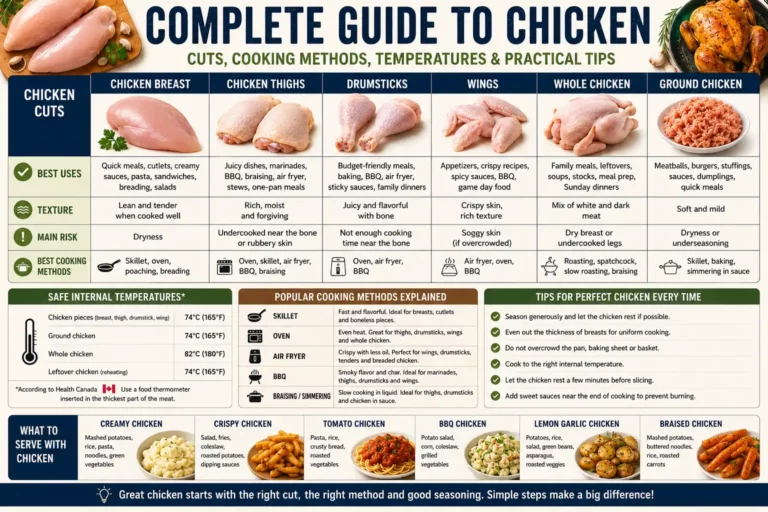
For chicken pieces, use 165°F / 74°C. That includes breasts, thighs, legs and wings. Health Canada lists poultry pieces at 74°C / 165°F, and the USDA lists all poultry at 165°F / 73.9°C. (Canada)
For whole poultry, Health Canada lists 180°F / 82°C. If cooking a whole chicken or turkey, check the thickest part of the breast and the inner thigh, without touching bone. Stuffing must reach 165°F / 74°C if cooked inside or outside the bird. (Canada)
Chicken recipes where internal temperature matters:
- Juicy air fryer chicken breast
- Air fryer chicken thighs
- Chicken thighs in the oven
- Chicken drumstick marinade
- 5 easy chicken marinades
The mistake to avoid is relying only on cooking time. A small chicken breast may cook quickly, while a thick one may take much longer. Use the thermometer in the thickest part and remove the chicken once it reaches the right temperature.
Ground Meat Temperatures
Ground meat needs special attention because grinding mixes the surface into the centre. That means the middle of a burger, meatball or meatloaf needs to reach a safe temperature.
For ground beef, pork, veal and lamb, use 160°F / 71°C. For ground chicken or turkey, use 165°F / 74°C. Health Canada also lists ground poultry at 74°C / 165°F and ground beef, veal, lamb and pork at 71°C / 160°F. (Canada)
This is important for:
- Burgers
- Meatballs
- Meatloaf
- Sausages
- Ground beef casseroles
- Ground chicken or turkey patties
Ground meat should not be judged by colour alone. A burger can brown before it reaches the right temperature, and some cooked ground meat can remain slightly pink.
For practical recipe ideas, see ground beef dinner recipes, meatballs in the air fryer, one-pot creamy beef and tomato pasta and easy ground beef dinner ideas.
Beef, Lamb and Veal Temperatures
Whole cuts of beef, lamb and veal are different from ground meat. With steaks, chops and roasts, doneness can range from medium-rare to well done depending on preference and safety guidance.
A practical chart:
| Doneness | Temperature |
| Medium-rare | 145°F / 63°C |
| Medium | 160°F / 71°C |
| Well done | 170°F / 77°C |
For USDA guidance, raw beef, pork, lamb and veal steaks, chops and roasts should reach 145°F / 63°C and rest at least 3 minutes. Health Canada also lists beef, veal and lamb whole cuts at 63°C / 145°F for medium-rare, 71°C / 160°F for medium and 77°C / 170°F for well done. (Food Safety and Inspection Service)
For home cooking, rest time matters. A roast or steak continues to redistribute heat after it comes off the pan, grill or oven. The temperature can rise slightly, and the juices settle before slicing.
Recipes where temperature is useful include filet mignon with peppercorn sauce, braised lamb shanks and steak with baked potato and garlic butter.
Pork Internal Temperatures
Pork guidance can vary between Canada and the USA. USDA guidance lists pork steaks, chops and roasts at 145°F / 63°C with a 3-minute rest, while Health Canada’s broader food safety chart has listed pork pieces and whole cuts at 160°F / 71°C in some guidance. (Food Safety and Inspection Service)
For a Canada and USA audience, the clearest approach is:
- Pork chops or pork loin, juicy style: 145°F / 63°C with rest, following USDA guidance
- Pork cooked more fully: 160°F / 71°C
- Ground pork, sausages and meat mixtures: 160°F / 71°C
Texture changes quickly with pork. A pork chop cooked to 145°F / 63°C and rested will be juicier than one cooked much higher. Ground pork and sausages should always be cooked to 160°F / 71°C.
Fish and Seafood Temperatures
Fish is delicate, so a thermometer helps avoid dry texture. USDA lists fish and shellfish at 145°F / 63°C. Health Canada lists fish at 158°F / 70°C and shellfish and crustaceans at 165°F / 74°C. (Food Safety and Inspection Service)
For home cooking:
- Fish should look opaque and flake easily
- Shrimp and scallops should be firm and opaque
- Clams, mussels and oysters cooked in the shell should open
- Discard any shellfish that do not open after cooking
If following the more conservative Canadian chart, use 158°F / 70°C for fish. If following USDA guidance, use 145°F / 63°C. For higher-risk eaters, the more conservative temperature is often the safer choice.
For seafood ideas, connect this guide with fish and seafood recipes if that page is available in your sitemap, or use individual seafood recipes already published on the site.
Egg Dishes, Casseroles and Leftovers
Egg dishes, casseroles and leftovers are easy to under-check because they often look cooked before the centre is hot enough.
Use these practical temperatures:
| Food | Temperature |
| Egg dishes | 160°F / 71°C in USDA guidance, 165°F / 74°C in Health Canada guidance |
| Casseroles | 165°F / 74°C |
| Leftovers | 165°F / 74°C |
| Stuffing | 165°F / 74°C |
USDA FSIS says leftovers should be reheated to 165°F as measured with a food thermometer. Soups, sauces and gravies should be reheated by bringing them to a rolling boil. (Food Safety and Inspection Service)
This matters for dishes like casseroles, creamy pasta bakes, meat pies, stuffed poultry and reheated chicken meals. For recipe inspiration, see easy casserole recipes, comfort food recipes and 30-minute dinners.
How to Use a Food Thermometer Correctly
A thermometer is only useful if it is used correctly.
Insert It in the Thickest Part
Place the probe in the thickest part of the food. For chicken breast, go into the thickest section. For burgers, insert from the side toward the centre. For roasts, check the centre.
Avoid bone, fat and the pan. Bone can give a misleading reading.
Check More Than One Spot
Large or uneven pieces can cook unevenly. Check the thickest pieces, not just the smallest one.
This is especially important for:
- Chicken thighs
- Whole poultry
- Roasts
- Burgers
- Casseroles
- Air fryer batches
- BBQ cooking
Clean the Thermometer
Wash the thermometer probe after touching raw or partially cooked food. Health Canada advises cleaning a digital food thermometer in warm, soapy water between readings. (Canada)
Let Food Rest When Needed
Resting matters for steaks, chops and roasts. It helps finish the cooking process and keeps the juices from running out immediately when sliced.
For chicken pieces and ground meat, the goal is to reach the safe temperature directly.
Temperature vs Time: Why Time Alone Is Not Enough
Cooking time changes depending on:
- Thickness
- Starting temperature
- Oven accuracy
- Pan material
- Air fryer model
- Grill heat
- Bone-in vs boneless cuts
- Batch size
- Whether the food is covered or uncovered
This is why two chicken breasts can take different amounts of time in the same oven. It is also why air fryer recipes can vary between brands and basket sizes.
Use time as a guide, but use internal temperature as the final check.
For air fryer cooking, this is especially important. Recipes like air fryer chicken thighs, air fryer chicken breast, air fryer meatballs and air fryer mozzarella sticks all depend on heat circulation, spacing and timing.
Common Mistakes to Avoid
Cutting Meat Open to Check Doneness
Cutting into meat lets juices escape and does not always show the true temperature. A thermometer is more accurate.
Touching Bone with the Thermometer
Bone can affect the reading. Insert the probe into the thickest meat, away from bone.
Checking Only the Smallest Piece
The smallest piece cooks fastest. Always check the thickest piece or the centre of the batch.
Ignoring Rest Time
Steaks, chops and roasts need rest time. Slicing too quickly can make them lose moisture.
Relying on Colour Alone
Colour is not a safe doneness test. Chicken can look white before it is safe, and ground beef can brown before reaching 160°F / 71°C.
Forgetting Leftovers
Leftovers should be reheated until hot throughout and reach 165°F / 74°C. This is especially important for casseroles, sauces, soups, rice dishes and chicken meals.
Not Cleaning the Thermometer
A thermometer that touches raw meat or poultry should be cleaned before it touches cooked food.
FAQ
What temperature should chicken be cooked to?
Chicken pieces and ground poultry should be cooked to 165°F / 74°C. Health Canada lists whole poultry at 180°F / 82°C.
What temperature should ground beef be cooked to?
Ground beef should be cooked to 160°F / 71°C. This includes burgers, meatballs, meatloaf and ground beef casseroles.
What temperature is medium-rare steak?
Medium-rare beef, veal or lamb is generally 145°F / 63°C. USDA guidance includes a 3-minute rest for steaks, chops and roasts.
What temperature should pork be cooked to?
For pork chops and roasts, USDA guidance lists 145°F / 63°C with a 3-minute rest. For ground pork or sausages, use 160°F / 71°C. Some Canadian guidance lists pork pieces and whole cuts at 160°F / 71°C.
What temperature should fish be cooked to?
USDA guidance lists fish at 145°F / 63°C. Health Canada lists fish at 158°F / 70°C. Fish should be opaque and flake easily.
What temperature should leftovers reach?
Leftovers should be reheated to 165°F / 74°C. Soups, sauces and gravies should be brought to a rolling boil when reheating.
Can I tell if chicken is done by colour?
No. Colour is not reliable. Use a food thermometer in the thickest part and cook chicken pieces to 165°F / 74°C.
Do I need a thermometer for air fryer recipes?
Yes, especially for chicken, meatballs, burgers and thicker foods. Air fryer models vary, so temperature is more reliable than timing alone.
Final Thoughts
An internal cooking temperature chart is one of the most useful references to keep in the kitchen. It helps you cook chicken safely, avoid dry meat, check burgers properly, reheat leftovers, and make better decisions with fish, pork, beef, casseroles and air fryer recipes.
The most important numbers to remember are simple: poultry at 165°F / 74°C, ground beef and pork at 160°F / 71°C, leftovers at 165°F / 74°C, and steaks or roasts at 145°F / 63°C with rest when following USDA guidance. When Canadian and American recommendations differ, choose the temperature that fits your comfort level and the people you are cooking for.
For more recipe ideas where temperature matters, explore chicken recipes, air fryer chicken thighs, juicy air fryer chicken breast, ground beef dinner recipes and easy 30-minute dinners.
Useful Links
🛒 Michel Dumas Shop : Explore our kitchen essentials, including aprons and knives.
🌐 Linktree : Access all our important links in one place.
📱 YouTube | Instagram | Facebook | TikTok : Follow us for the latest recipes and culinary tips.


thanks