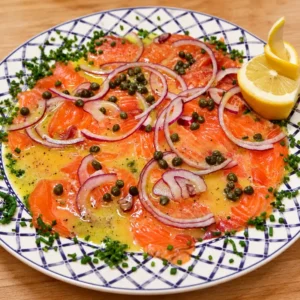
Salmon Carpaccio with Lemon, Capers and Red Onion
This salmon carpaccio combines paper-thin salmon slices with a lemon and olive oil dressing, red onion, capers, and chives. I serve it cold as a simple appetizer, with just enough dressing to brighten the fish and a few crisp onion rings for contrast.

{VIDEO}
A simple salmon appetizer with a bistro finish
Carpaccio is all about a thin slice and a careful finish. In this video, I arrange the salmon directly on a patterned plate, add red onion and capers, then finish with dressing and chives. There is no cooking step. A little attention to the fish, the knife, and the seasoning makes the difference between a delicate appetizer and a plate overwhelmed by oil or onion.
The preparation shares familiar flavors with my salmon tartare with lemon, Dijon and capers, but the texture is different. Tartare is chopped; carpaccio is sliced into broad, thin pieces. If you like a more assertive seasoning, try Asian salmon tartare with ginger and soy another day rather than adding every sauce to this plate.
The recipe below makes four appetizer portions. Prepare the garnishes first, keep the salmon refrigerated, and dress each plate immediately before serving. The measured amounts provide a practical home batch; the video demonstrates the technique without a complete weighed ingredient list.
Ingredients and equipment

Use a skinless, boneless salmon fillet supplied specifically for raw consumption. Tell your fishmonger you are making carpaccio and ask about appropriate parasite controls and handling. Ordinary freshness, appearance, or a brief spell in the freezer does not establish that fish is suitable to eat raw.
For four starters, use 14 oz salmon, 3 tbsp olive oil, 1 tbsp strained lemon juice, about 1/4 small red onion, 2 tbsp drained capers, and 2 tbsp chopped chives. Add a little freshly ground pepper and salt only as needed. Extra lemon wedges are optional. Start with these modest amounts: you can add a little dressing, but you cannot easily remove it once it pools around the fish.
Choose an olive oil whose flavor you enjoy on its own. A very bitter oil can dominate delicate salmon. Strain the lemon juice to keep seeds out, drain the capers, and slice the onion finely enough that each piece bends easily. The two-minute lemon vinaigrette is a useful related recipe, while my classic vinaigrette explains another everyday dressing for salads.
A long, sharp slicing knife is helpful. You also need a clean cutting board, a small bowl or measuring jug, a whisk, and four chilled plates. A blender can combine the dressing as in the video, but a whisk is sufficient for this small quantity. Prepare the herbs and onion before working with the fish, and keep utensils and work surfaces clean.
Raw salmon: the essential preparation note
Raw seafood carries a risk of foodborne illness. Buy salmon intended for raw service from a supplier who can confirm appropriate parasite controls, such as validated freezing where required. Previously frozen does not mean free of every harmful germ. Thaw according to the supplier’s instructions in the refrigerator and keep the fish at 40°F or colder until preparation.
Lemon juice changes the surface and flavor of salmon; it does not replace cooking or parasite controls. Briefly firming fish for slicing is also not a parasite-destruction process. Pregnant people, children, older adults, and people with weakened immune systems should avoid raw seafood. The FDA guidance on selecting and serving seafood gives the underlying handling advice. For a cooked option, choose oven-baked salmon instead.
How to make salmon carpaccio
Step 1: Prepare the lemon dressing

Whisk the strained lemon juice with pepper and a small pinch of salt, if needed. Add the olive oil gradually and whisk until combined. For the home batch below, I use 3 tbsp olive oil and 1 tbsp lemon juice: three parts oil to one part juice. This measured adaptation gives a starting point for a balanced dressing; taste before adding it to the fish. Taste the dressing on its own; it should be bright, but the lemon should not overwhelm the fish. The capers will bring additional salt to the finished plate.
Keep the dressing separate while you prepare the salmon. If it separates, whisk again before using. This is a simple lemon and oil dressing; mustard is not needed for this version. My quick mustard vinaigrette is a different option for the side salad.
Step 2: Slice the cold salmon

Check that the fillet has no skin or pin bones, then pat the surface dry. Keep it cold and use a long, shallow stroke with the knife to shave thin slices at an angle across the fillet. Aim for flexible slices about 1/16 inch thick. A sharp blade and a gentle pulling motion help more than pressing down hard or sawing repeatedly.
If the salmon is too soft to slice neatly, chill it briefly until firmer and workable. This is only a texture aid, and it does not replace the supplier’s parasite-control treatment. Return any fish you are not slicing immediately to the refrigerator. Uneven scraps can be reserved for a thoroughly cooked dish rather than forced into thick pieces on the carpaccio plate.
Step 3: Arrange the salmon on chilled plates

Divide the slices among four chilled plates, spreading them into a single layer with a slight overlap. Use about 3 1/2 oz fish per person for a starter. Avoid folding the pieces into thick piles: the broad, thin layer is what gives carpaccio its delicate texture.
The video adds some dressing beneath the salmon. For more control, brush just a little beneath the slices and save most for the finish. You want a glossy surface, not a deep puddle. Refrigerate the plated fish while you finish the garnishes if there is any delay.
Step 4: Add red onion and capers

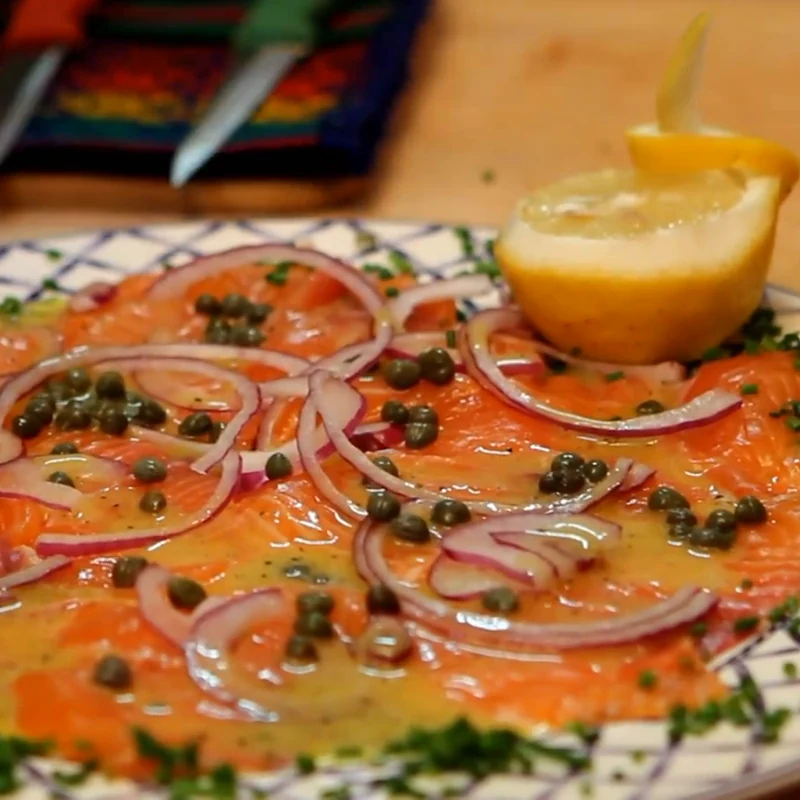
Slice the onion into thin rings or crescents and separate the layers. Scatter a small amount across each plate, then distribute the drained capers. Leave plenty of salmon visible. Onion gives crunch and capers bring a briny accent, but neither should dominate every bite.
If the onion tastes very sharp, rinse the slices briefly in cold water and dry them well before adding. Do not pour caper brine onto the fish; it introduces extra salt and liquid that the measured dressing does not need.
Step 5: Dress lightly

Whisk the dressing again and spoon it sparingly over the salmon. The full batch is about 4 tbsp. Start with less than 1 tbsp per portion, including any used under the fish, and add more only if needed. You do not have to use every drop. Add pepper to taste and assess whether any extra salt is needed after considering the capers.
Dress at the last moment. A long soak in lemon juice changes the texture and makes the edges more opaque. That change is not evidence that the fish has been safely cooked. Serve this as freshly assembled carpaccio rather than a long-marinated preparation.
Step 6: Finish with chives and serve

Scatter the chopped chives over the fish or around the rim as in the video. Add a lemon wedge if you like; the decorative carved lemon shown in the video is optional. Wipe the rim and serve immediately while the plate is cold.
For a complete table, pair small portions with grated carrot salad with mustard vinaigrette or chickpea, cucumber and tomato salad. If some guests prefer cooked fish, pan-seared salmon offers an easy alternative without asking everyone to eat raw seafood.
Substitutions and variations
Dill can replace chives for a different herb finish. A little shallot can replace red onion, but keep it very finely sliced and use a modest amount. If capers are unavailable, leave them out and adjust the salt carefully; olives will produce a different, stronger flavor.
Smoked salmon changes the dish into a smoked-salmon appetizer and is not a direct equivalent to fresh carpaccio. For another preparation, see my salmon rillettes. For this recipe, avoid piling on avocado, cream, or several sauces: a short ingredient list keeps the thin slices at the center of the plate.

Frequently asked questions
Can I prepare salmon carpaccio ahead?
Prepare the dressing, onion, capers, and chives separately ahead of serving. Slice and plate the salmon close to serving, keep it refrigerated, and add the dressing at the last moment. Follow the supplier’s use-by instructions. This recipe is not intended as a leftover meal or a plate to leave on a buffet.
Does lemon juice cook the salmon?
It changes the proteins at the surface, but it does not provide the safety of heat cooking. The fish must still be suitable for raw consumption and handled cold. Do not use lemon, salt, or a short freeze to compensate for uncertain sourcing.
Why are my slices tearing?
The fish may be too soft or the knife too blunt. Keep the fillet cold, sharpen the blade, and draw it through in long strokes. Do not try to cut a soft fillet by pressing straight down with a short knife. Slightly uneven slices are fine; thick folded pieces are less pleasant.
Why is the plate oily or too sour?
Too much dressing is the usual cause. Begin with the home adaptation’s three-to-one oil-to-lemon ratio and add a small amount per plate. For a milder dressing, whisk in extra oil until the balance suits you. If your lemon is particularly sharp, adjust the dressing before it goes on the fish. Capers and extra squeezed lemon also affect the final balance.
Is this a full meal?
The listed portions are appetizers. Add suitable sides if you want a light meal, or make a cooked salmon dish for a more substantial main course. My collection of salmon recipes offers several approaches.
RECIPE CARD
Summary: This salmon carpaccio combines paper-thin salmon slices with a lemon and olive oil dressing, red onion, capers, and chives. I serve it cold as a simple appetizer, with just enough dressing to brighten the fish and a few crisp onion rings for contrast.
Ingredients:
14 oz skinless, boneless salmon supplied for raw consumption with appropriate parasite controls
3 tbsp olive oil
1 tbsp strained fresh lemon juice
1/4 small red onion, very thinly sliced, about 1/4 cup loose slices
2 tbsp capers, drained
2 tbsp fresh chives, finely chopped
1/8 tsp freshly ground black pepper, or to taste
1 small pinch salt, optional and to taste
4 lemon wedges, optional garnish
Instructions:
1. Prepare clean utensils and chilled plates. Keep the salmon refrigerated at 40°F or colder until slicing; follow the supplier’s raw-service and thawing instructions.
2. Whisk lemon juice, pepper, and optional salt with the olive oil. Set aside and whisk again before serving.
3. Pat the cold salmon dry, check for bones, and slice it thinly at an angle with a sharp knife, about 1/16 inch thick.
4. Divide the slices into a single lightly overlapping layer on four chilled plates. Brush a little dressing underneath if desired.
5. Scatter thin onion slices and drained capers over the fish. Spoon the remaining dressing lightly on top, starting with about 1 tbsp total per portion.
6. Finish with chives and optional lemon wedges. Serve immediately. Keep plated fish refrigerated if there is any delay; do not treat lemon juice or brief chilling as a safety treatment.
Prep Time: 20
Cook Time: 0
Servings: 4
Calories: 315
Cuisine: French
Tags: salmon carpaccio, raw salmon, appetizer, lemon, capers, no cook
Notes:
Calories are approximate per appetizer portion, assuming all dressing is used.
Measured quantities and the dressing ratio are a home-batch adaptation, not a complete weighed list quoted from the video. Supplier processing and thawing time are not included in prep time.
Use fish supplied for raw consumption with confirmed appropriate parasite controls. Freezing does not remove every harmful germ; cooking is safer. Pregnant people, children, older adults, and people with weakened immune systems should avoid raw seafood.
Keep cold, dress just before serving, and follow supplier use-by instructions. Lemon juice does not make unsuitable raw fish safe.